

For investors looking for a disciplined, long-term method to build wealth, few strategies are as respected as Peter Lynch's approach. The famous manager of the Fidelity Magellan Fund supported a "growth at a reasonable price" (GARP) idea, concentrating on companies with durable growth, good financial condition, and prices that do not overvalue that future prospect. His strategy, explained in One Up on Wall Street, stresses fundamental study and a buy-and-hold perspective, avoiding market timing. It looks for businesses increasing earnings at a good rate, not too low, but not so high that it cannot last, while selling at a price that pays the investor for the risk.
A recent filter using Lynch's main rules has identified a well-known leader: Amazon.com Inc (NASDAQ:AMZN). While Amazon is not a hidden high-return stock, using Lynch's enduring filters on this retail and cloud giant shows why it still fits within a GARP investment model.
Looking at Amazon With Lynch's Criteria
Peter Lynch’s filter uses clear, measurable rules to find companies deserving more study. Amazon’s present financial picture matches many of these important measures, which are made to select for lasting growth, earnings, and financial soundness.
- Lasting Earnings Growth: Lynch wanted companies with a 5-year earnings per share (EPS) growth rate between 15% and 30%, high enough to be interesting, but moderate enough to be continued. Amazon’s EPS has increased at an average yearly rate of 27.98% over the past five years, putting it at the top end of this wanted range. This shows a steady and significant rise in earnings.
- Sensible Price Compared to Growth: The Price/Earnings to Growth (PEG) ratio is a key part of Lynch's strategy, as it relates a stock's price to its growth rate. A PEG ratio at or under 1 implies the market may not be valuing future growth too highly. Amazon’s PEG ratio, based on its past five-year growth, is 0.99, meeting Lynch's mark for a sensible price.
- High Earnings: Lynch needed a high Return on Equity (ROE) to make sure management is using shareholder money well. His filter requires an ROE above 15%. Amazon’s ROE of 18.89% easily passes this level, showing good use of capital across its large e-commerce and cloud computing operations.
- Prudent Financial Setup: A liking for equity over debt is another Lynch trait, with a Debt/Equity ratio below 0.6 being a basic filter. Amazon’s D/E ratio of 0.16 is not only within this limit but matches Lynch's stricter personal choice for ratios below 0.25, indicating a very sound balance sheet with little financial danger.
- Sufficient Near-Term Financial Condition: The Current Ratio, checking a company's ability to pay short-term debts, is required to be at least 1. Amazon’s ratio of 1.05 meets this basic cash need, suggesting it has enough current assets to handle its upcoming bills.
Basic Condition Review: A Summary
A wider fundamental analysis of Amazon gives more detail beyond the filter's rules. The company gets a good total score, with its strong and weak points showing a picture of an established but still increasing sector frontrunner.
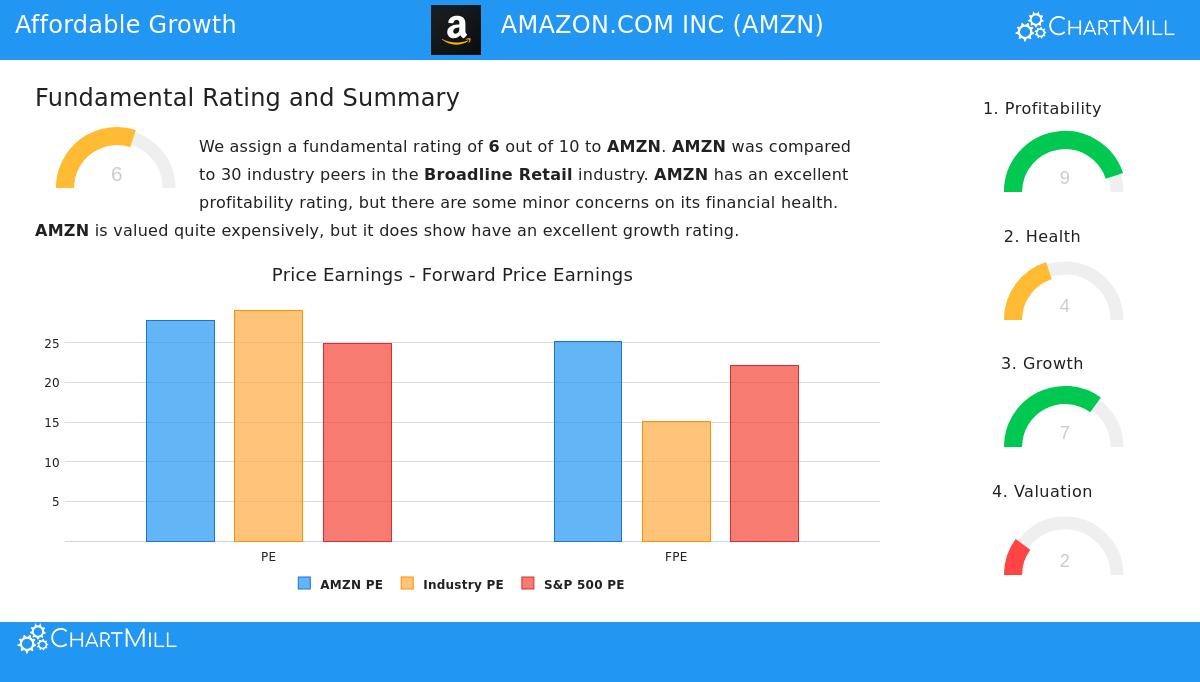
- Earnings is a Key Strong Point: Amazon scores very high (9 out of 10) on earnings. It has top-tier margins, with a Profit Margin of 10.83% and an Operating Margin of 11.16%. Its returns on assets, equity, and invested capital all rank in the best group of its general retail competitors, highlighting the quality of its profits.
- Growth Path Continues: The company displays good past growth in both sales and EPS, and experts predict solid double-digit growth to keep going in the next years. This steady growth picture is key to the GARP argument.
- Price Presents a Challenge: The most clear warning from the basic report is on price, which scores a low 2 out of 10. With a P/E ratio near 28, Amazon is seen as costly on a simple basis, though it matches the wider S&P 500. The PEG ratio near 1, however, is the measure that Lynch supporters would note as the important balance, implying the higher price may be reasonable given the growth rate.
- Financial Condition Has Details: Amazon’s financial condition score is varied. Its excellent Debt/Equity and Altman-Z scores indicate long-term stability and low failure risk. However, its cash measures, like the Quick Ratio, are lower than many sector competitors, a sign of the asset-heavy nature of its logistics network.
Is Amazon a "Lynch" Stock Now?
Using Peter Lynch’s strategy today is more about applying a strict model for judging any company’s long-term possibility than finding unknown, small company chances. Amazon satisfies the number-based tests Lynch supported: excellent but lasting historical growth, high earnings, a very strong balance sheet, and a price that, when growth is considered, does not seem extreme.
For the long-term GARP investor, Amazon serves as an example of a leading company that still meets the rules of careful growth investing. It shows Lynch’s rule of knowing the business you own, a company that has become essential to global trade and cloud systems. The main discussion for investors is whether its present price already accounts for its future growth, a question that requires personal study and belief.
Find Other Possible Choices The Peter Lynch strategy filter that found Amazon is updated and can find other companies matching this GARP description. You can view the present results and use the filter yourself through this link: Peter Lynch Strategy Stock Screen.
Disclaimer: This article is for information only and does not make up financial guidance, a suggestion, or an offer to buy or sell any security. The study is based on data and a particular investment strategy model, it is not a replacement for your own research, financial position, or risk comfort. You should talk with a qualified financial advisor before making any investment choices.